Date
|
Minutes of our meetings (What we discussed/How we spent our time)
|
Jan 9
|
Syllabus. Text.
Schedule for HW/Quizzes/Exams.
We discussed CE/BCE notation for dating. (No year zero.)
We discussed a coarse timeline of development for Homo sapiens.
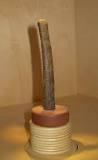
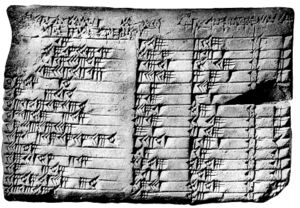
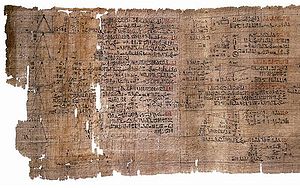
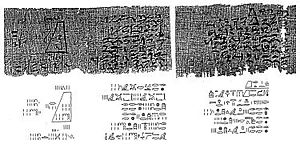
We discussed some of the the earliest mathematical objects/writings,
namely:
The Ishango bone:
Plimpton 322:
The Rhind papyrus:
The Moscow papyrus:
|
Jan 12
|
Read Sections 1.1-1.3, 1.7.
We discussed an
ancient algorithm for how to solve the
simultaneous system $x+y=s, xy=p$ for $x$ and $y$,
and explained why this was equivalent to solving
a general quadratic equation.
We gave three proofs of the Pythagorean Theorem
(the Bride's Chair proof from Euclid's Elements, one proof without words,
and James Garfield's proof).
Here are 118 proofs of the Pythagorean Theorem. The proofs we saw in class are proofs 1, 3, and 5. The 13 remarks preceding the first proof are interesting.
|
Jan 14
|
Read Sections 1.1-1.3, 1.7.
Today, we discussed Section 1.3 of the book.
Namely, we discussed Pythagorean triples
and how to use the Chord and Tangent Method to develop
a parametrization of all Pythagorean triples.
The session ended with a Challenge Problem:
find all Pythagorean triples that form an arithmetic progression.
The solution is
here.
|
Jan 16
|
Read Section 1.5.
Irrational numbers.
Commensurability: We defined segments $a$ and $b$
to be commensurable if there is a
segment $c$ and positive whole numbers
$m$ and $n$ such that $|a| = m*|c|$,
$|b| = n*|c|$.
We mentioned that $a$ and $b$ are
commensurable iff the ratio of their
lengths is a rational number.
We mentioned Hipassus,
whose is credited with discovering the existence of irrational numbers.
We proved $\sqrt{2}$ is irrational by reductio ad absurdum
using an arithmetical argument.
We then examined a false proof by ChatGPT for the statement that
$\sqrt{18}$ is irrational.
Finally, we discussed a geometric proof that $\sqrt{2}-1$ is irrational,
and used this to deduce that $\sqrt{2}$ is also irrational.
|
Jan 21
|
Read Sections 1.5 and 3.3.
We reviewed the discussion on Irrational numbers from Jan 16.
We defined the Golden Ratio and gave a
geometric argument that it is irrational.
We began discussing the Euclidean algorithm in the following way.
We started with the structure
$\mathbb{N}=\langle \{0,1,2,\ldots\}; 0, S(x), +, \cdot\rangle$
and defined the additive order on $\mathbb{N}$:
$m\leq n$ iff $(\exists k)(m+k=n)$.
Then we defined the multiplicative order on $\mathbb{N}$:
$m\leq n$ iff $(\exists k)(m\cdot k=n)$.
We drew the Hasse diagrams for these orders and showed that
these posets are lattices.
This means that, in each poset, any two elements $x$ and $y$
have a least upper bound $x\vee y$ ( = the join of $x$ and $y$)
and a
a greatest lower bound $x\wedge y$ (the meet of $x$ and $y$).
In the additive order,
$m\wedge n = \min(m,n)$ and
$m\vee n = \max(m,n)$.
In the multiplicative order,
$m\wedge n = \textrm{lcm}(m,n)$ and
$m\vee n = \gcd(m,n)$.
The Euclidean algorithm explains how to compute the multiplicative meet and join using the additive meet and join.
Quiz 1.
|
Jan 23
|
Read Section 3.3.
We discussed the facts that (i) the additive order on $\mathbb{N}$
is a well order. (ii) the additive order on $\mathbb{N}^+$
is a linear extension of the multiplicative order on $\mathbb{N}^+$.
(iii) There is no infinite, strictly descending chain in $\mathbb{N}$
under either the additive order or the multiplicative order.
These facts were shown to ensure that algorithms
terminate. (Any algorithm on $\mathbb{N}$ that successively
returns strictly smaller numbers must terminate, else
an infinite, strictly descending chain of natural numbers will be produced.)
Next, we introduced the Euclidean Algorithm, and used
it to show that $\gcd(21,8) = 1$.
The following handout was circulated.
|
Jan 26
|
We discussed
How to answer a question.
We worked through
this handout
Quiz 2.
|
Jan 28
|
I promised to discuss consequences of the Euclidean algorithm including:
- Bézout's identity. (Did it!)
- Irreducibility implies primality in $\mathbb{Z}$. (Did it!)
- The Fundamental Theorem of Algebra. (Did not get this far!)
|
Jan 30
|
Read Sections 2.1-2.2.
We discussed the following topics.
- The Fundamental Theorem of Algebra.
(Every positive integer can be factored into primes in a unique way, up to the order of the primes.)
- (Section 2.1)
Euclid's Elements are presented in the form of
“theorems”,
which are accompanied by “proofs” from the
“axioms”.
- (Section 2.2)
We explained why there can be at most 5 regular polyhedra (= polyhedra
where any two sides
are congruent regular polygons and the same number of
sides meet at each vertex). We then discussed the fact that all
5 possibilities can be realized (= the Platonic Solids =
tetrahedron, cube, octahedron,
dodecahedron, icosahedron). We pointed out that every
Platonic Solid has a dual solid.
We discussed Luca Pacioli's construction
of the icosahedron. We worked on
this handout where we recorded some
numerical data
about the Platonic Solids.
|
Feb 2
|
Read Section 2.3.
We began a discussion of Euclid's Elements, including
- a brief description of the contents,
- a discussion of the five axioms of plane geometry,
Quiz 3.
|
Feb 4
|
Read Section 2.3.
We discussed straightedge and compass constructions, including:
- Allowable tools.
- Meaning of “construction”
- Meaning of Constructible
-
points,
-
lines,
-
segments,
-
rays,
-
angles,
-
circles,
-
ETC.
- Construction of coordinate axes.
- Orthogonal projections,
construction of lines orthogonal to a give line at a give point,
assigning coordinates to points.
- We made some references to Ordered Fields,
but we will say more about them on Friday, Feb 6.
We ended our meeting by stating the Three
Classical Greek Construction Problems:
Duplication of the Cube, Trisecting a general angle, and
Squaring the Circle.
|
Feb 6
|
Read Section 2.3.
We showed that the problem of determining the
constructible points in the plane can be reduced
to the problem of determining the constructible real numbers.
We explained why the constructible numbers form
the least Euclidean field.
We discussed why $\pi$ and $\sqrt[3]{2}$ are not constructible numbers.
|
Feb 9
|
We discussed properties
of the the smallest field $\mathbb{E}_0$ (without proof!)
and referenced those properties to show that
three classical Greek constructions problems are
not solvable with straightedge and compass.
Quiz 4.
|
Feb 11
|
Today we discussed the theorem which says that the following
are equivalent about a number $n$:
- a regular $n$-gon is constructible with straightedge and compass.
- $\cos(2\pi/n)$ is a constructible number.
- $\cos(2\pi/n)$ has minimal polynomial whose degree is a power of $2$.
- $\phi(n)$ is a power of $2$.
- $n=2^r\cdot p_1\cdots p_s$ for some $r\geq 0$ and distinct
Fermat primes $p_1,\ldots,p_s$.
We defined the Euler phi-function, $\phi(n)$,
and Fermat primes. We listed the known Fermat primes,
$3, 5, 17, 257, 65537$.
|
Feb 13
|
We reviewed the straightedge and compass construction of
square roots. Then, we worked together in groups on
this handout
about Euclidean fields.
|
Feb 16
|
Read Section 3.4.
We discussed the Cattle Problem
of Archimedes and its connection
to Pell's Equation.
Notes.
Quiz 5.
|
Feb 18
|
Read Section 3.4 and examine
the exercises from Section 9.4
to see more examples of continued fraction expansions.
We continued our discussion of
Pell's Equation, focusing on applications
of continued fractions.
Notes.
Some interesting side quests:
we explained how continued fractions can be
used to solve Bézout's Identity
and also can be used to give optimal rational approximations
to irrational numbers.
|
Feb 20
|
We practiced with Pell's equation following
this handout.
(Solutions!)
I circulated
this midterm review sheet.
|
Feb 23
|
We discussed Eudoxus' Theory of Proportions.
Then we discussed Archimedes' Quadrature of
a Parabolic Segment using Method of Exhaustion.
The explanation involved a geometric
argument that $\sum_{n=1}^{\infty} \left(\frac{1}{4}\right)^n=\frac{1}{3}$.
We ended the class with this
Community Quiz!
|
Feb 25
|
We reviewed for the Feb 27 midterm following
this midterm review sheet
and
this sheet of practice questions.
|
Feb 27
|
Midterm!
|
Mar 2
|
Read Section 5.2.
We defined congruences on $\mathbb{Z}$,
and stated that every congruence on
$\mathbb{Z}$ is equal to “congruence modulo $m$”
for some nonnegative $m\in \mathbb{Z}$.
We then discussed the Chinese Remainder Theorem
following
these notes.
|
Mar 4
|
Read Section 5.2.
We discussed the Chinese Remainder Theorem further, and continued
working on
these notes.
|
Mar 6
|
Read Sections 6.1-6.5, 6.8.
We began discussing the problem
of solving polynomial equations.
We spent most of the time discussing
the Cardano formula following
these slides.
|
Mar 9
|
Read Sections 6.1-6.5, 6.8.
We continued discussing the solution to the
cubic formula following
these slides.
Quiz 7.
|
Mar 11
|
We discussed two things today:
- the possible signs of an $n$-th root ($\sqrt[n]{x}$).
- the quartic formula.
|
Mar 13
|
Practice with cubics and quartics!
|
Mar 23
|
We starting discussing higher order polynomial equations in one variable.
This included:
- The fact that quintics can be solved by extraction of
2nd, 3rd, and 5th roots and Bring radicals.
- The description of the Galois group of a polynomial $f(x)$.
- The fact that $|\textrm{Gal}_{\mathbb{Q}}(f)|\leq n!$
when $n=\textrm{deg}(f)$.
- We discussed the polynomial $f(x)=x^4+1$,
and explained why some permutations of its roots
cannot preserve all rational relations satisfied by the roots.
(In fact, $|\textrm{Gal}_{\mathbb{Q}}(x^4+1)| = 4\ll 4!$, so most permutations
of the roots of $x^4+1$ will not preserve all rational
relations satisfied by the roots.)
No Quiz!
|
Mar 25
|
Read Sections 6.7, 6.8, 19.3, 19.9.
We completed our discussion of
higher order polynomial equations in one variable.
This included:
- The definition of the Galois group of a polynomial over $\mathbb{Q}$.
- The statement of the Galois Correspondence.
- A description of
$\textrm{Gal}_{\mathbb{Q}}(x^4+1)$, its intermediate subgroups,
and the corresponding intermediate subfields
between $\mathbb{Q}$ and $\mathbb{Q}[\alpha]$ for a
primitive $8$th root $\alpha$ of $1$.
- A brief description of a criterion for solvability by radicals
for higher order polynomial equations in one variable.
|
Mar 27
|
Read Sections 8.1-8.3.
We began discussing new developments
in geometry between 1630-1900.
We focused mostly on Projective geometry.
We gave the axioms for projective planes
and examined some examples, e.g.
the Fano Plane, and $\mathbb{F}\mathbb{P}^2$
for a field $\mathbb{F}$.
|
Mar 30
|
Read Sections 8.3-8.4.
We stated Desargues Theorem, and explained why
it suggests the need for points at infinity and lines at infinity.
We reviewed the construction of $\mathbb{F}\mathbb{P}^2$
from a field $\mathbb{F}$.
We briefly indicated how points in $\mathbb{F}\mathbb{P}^2$
may be assigned homogeneous coordinates. (This is something explained
more thoroughly in this handout.)
We described a 9-element nearfield $\mathbb{NF}_9$ with the property
that Desargues Theorem fails in $\mathbb{NF}_9\mathbb{P}^2$.
Quiz 8.
|
Apr 1
|
We discussed visualizations of the project plane
$\mathbb{R}\mathbb{P}^2$:
One as a quotient of $\mathbb{R}^3-\{\textrm{origin}\}$
that identifies two points if they lie on the same
line through the origin,
one as a quotient of the sphere that identifies antipodal points,
and one as an extension of ordinary plane $\mathbb{R}^2$ by adjoining
a line at infinity.
We spent time working on 1(a)-(c) of this handout.
|
Apr 3
|
We spent time working on the remaining
exercises from this handout.
|
Apr 6
|
We discussed
Bézout's Theorem about
the number of intersection points of two plane algebraic curves
in $\mathbb{C}\mathbb{P}^2$. We learned that, given
algebraic curves of degrees $m$ and $n$ that share no common component,
the number of intersection points in $\mathbb{C}\mathbb{P}^2$
will be $mn$
provided we count the intersection points with correct multiplicity.
We discussed how to compute the intersection
multiplicity of two curves at a point of intersection
following this handout.
Quiz 9.
|
Apr 8
|
We discussed applications of
Bézout's Theorem. For example,
we derived from this theorem that
two points are sufficient to
determine a line, five points are sufficient to
determine an ellipse, and ten points
are sufficient to determine a cubic.
We discussed an example showing that
nine points
are not sufficient to determine a cubic.
We ended class by stating the Cayley-Bacharach
“8 implies 9” Theorem.
|
Apr 10
|
Briefly read Sections 18.1, 18.3, 18.5
We compared Euclidean Plane Geometry, Projective Plane Geometry,
and Hyperbolic Plane Geometry. We explained how to determine
the points, lines, incidence relation, betweenness relation,
congruence of segments relation, and congruence
of angles relation in the disk model of Hyperbolic Plane Geometry.
We explained why the Parallel Postulate does not hold in
the disk model. We ended the lecture by reflecting on the implication
$$
E_1\wedge E_2\wedge E_3\wedge E_4\Rightarrow E_5
$$
where $E_i$ is the $i$th axiom of Euclidean geometry.
We asked: what does it mean for a statement to be provable
from a set of hypotheses? How do we know if a proof system is sound?
complete? decidable? What is the role of models/countermodels?
|
Apr 13
|
Today we discussed the formalization of
of mathematical reasoning from Gottlob Frege
(1848-1925) to Kurt Gödel (1906-1978).
For part of the discussion
we followed these notes
(pages 1-10).
Quiz 10. (Last one!)
|
Apr 15
|
We began a discussion of Hilbert's Problems.
(This material is not in our textbook.)
We said a few words about the life and work of
David Hilbert.
We then began discussing the influence of
Hilbert's
Problems.
We started discussing the first problem in detail:
the Continuum
Hypothesis (CH).
We described some of the
ZFC
axioms. We discussed
countable versus
uncountable
sets.
We explained the Cantor diagonalization argument,
which shows that $[0,1]$ is uncountable.
We defined ordinal and cardinal numbers.
|
Apr 17
|
We concluded the discussion of Hilbert's First Problem
(The Continuum Hypothesis).
(This material is not in our textbook.)
We started our meeting
by reviewing the axioms of ZFC.
Then, we briefly explained the work of Gödel and Cohen,
which together establish the undecidability of CH.
We concluded by stating the possibilities for
$|\mathbb{R}|$.
Final Exam review sheet
|
Apr 20
|
We discussed Dehn's solution to Hilbert's third
problem. We began by discussing equidecomposability
in the plane. We discussed the Wallace-Bolyai-Gerwien Theorem.
We then defined the Dehn Invariant, which takes
values in $\mathbb R\otimes_{\mathbb{Z}} [0,\pi)$.
We computed the Dehn Invariant of the cube.
We stated the Dehn-Sydler Theorem.
Final Exam review sheet
|
Apr 22
|
We discussed the solution to Hilbert's seventh
problem by Gelfond and Schneider, and
used it to prove that $e^{\pi}$ is transcendental.
Then we discussed the solution to Hilbert's tenth
problem by Davis, Robinson, Putnam, and Matiyasevich.
Final Exam review sheet
|
Apr 24
|
We reviewed for the
April 27 (4:30-7pm)
Final Exam following
this Final Exam review sheet
and
this sheet of practice questions.
|