\( % ---------- Blackboard bold ---------- \newcommand{\QQ}{\mathbb{Q}} \newcommand{\RR}{\mathbb{R}} \newcommand{\CC}{\mathbb{C}} \newcommand{\FF}{\mathbb{F}} \newcommand{\NN}{\mathbb{N}} \newcommand{\ZZ}{\mathbb{Z}} \newcommand{\HH}{\mathbb{H}} \newcommand{\SS}{\mathbb{S}} \newcommand{\PP}{\mathbb{P}} \newcommand{\KK}{\mathbb{K}} % ---------- Short alternative names ---------- \newcommand{\Z}{\mathbb{Z}} \newcommand{\R}{\mathbb{R}} \newcommand{\Q}{\mathbb{Q}} \newcommand{\N}{\mathbb{N}} \newcommand{\C}{\mathbb{C}} \newcommand{\F}{\mathbb{F}} % ---------- Operator names ---------- \newcommand{\PSL}{\operatorname{PSL}} \newcommand{\SL}{\operatorname{SL}} \newcommand{\SO}{\operatorname{SO}} \newcommand{\GL}{\operatorname{GL}} \newcommand{\PGL}{\operatorname{PGL}} \newcommand{\Per}{\operatorname{Per}} \newcommand{\Gal}{\operatorname{Gal}} \newcommand{\disc}{\operatorname{disc}} \newcommand{\rank}{\operatorname{rank}} \newcommand{\Stab}{\mathrm{Stab}} \newcommand{\Orb}{\mathrm{Orb}} \newcommand{\tr}{\mathrm{tr}} \newcommand{\Coefs}{\operatorname{Coefs}} \newcommand{\Roots}{\operatorname{Roots}} \newcommand{\hyp}{\operatorname{hyp}} % ---------- Special objects ---------- \newcommand{\bfv}{{\mathbf v}} \newcommand{\cir}{\mathcal{C}} \newcommand{\cpack}{\mathcal{A}} \newcommand{\mmod}{\!\!\!\!\mod} % ---------- Matrices and symbols with arguments ---------- \newcommand{\smcol}[2]{\left(\begin{smallmatrix}#1\\#2\end{smallmatrix}\right)} \newcommand{\sm}[4]{\left(\begin{smallmatrix} #1 & #2\\#3 & #4\end{smallmatrix}\right)} \newcommand{\lm}[4]{\left(\begin{matrix} #1 & #2\\#3 & #4\end{matrix}\right)} \newcommand{\genmtx}{\sm{a}{b}{c}{d}} \newcommand{\dkron}[2]{\left(\dfrac{#1}{#2}\right)} \newcommand{\kron}[2]{\left(\frac{#1}{#2}\right)} \newcommand{\quartic}[2]{\left[ \frac{#1}{#2} \right]} \newcommand{\norm}[1]{\left\|#1\right\|} \newcommand{\abs}[1]{\left|#1\right|} \)

Algebraic Starscapes and Schmidt arrangements

Views on the Farey tesselation

Katherine E. Stange

Farey’s Legacy in Frieze Patterns and Discrete Geometry, April 21, 2026

The Farey tesselation

The Farey tesselation is … organizing the rationals

\[ \frac{a}{b} \rightarrow \frac{a+c}{b+d} \leftarrow \frac{c}{d}\]

The Farey tesselation is … organizing the rationals

\[ \text{size} \sim \text{arithmetic simplicity} \sim \frac{\text{small constant}}{\text{denominator}^2}\]

The Farey tesselation is … organizing the rationals

Organizing the quadratics (with Edmund Harriss and Steve Trettel)
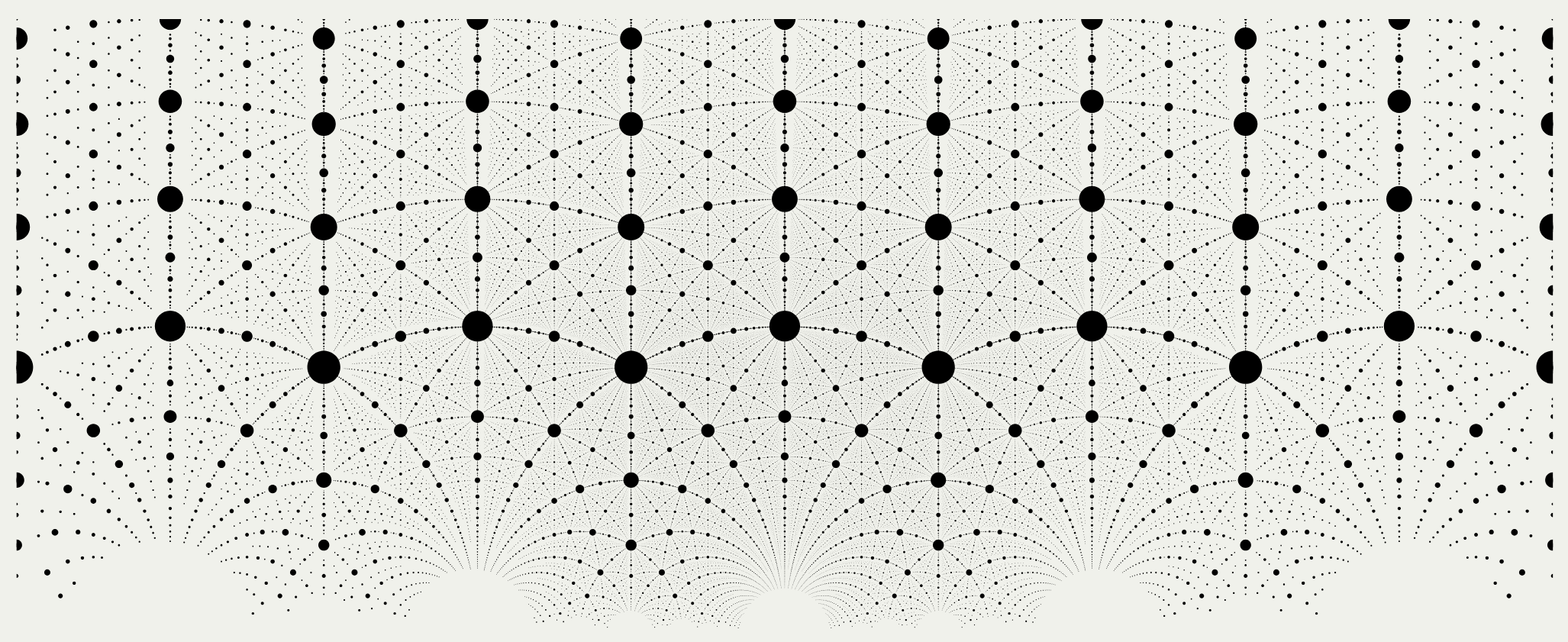
Rational = root of \(ax + b, \quad a,b \in \ZZ\)

Quadratic = root of \(ax^2 + bx + c, \quad a,b,c \in \ZZ\)

Organizing the quadratics (with Edmund Harriss and Steve Trettel)

\[\text{size} \sim \text{arithmetic simplicity} \sim \frac{\text{small constant}}{\text{discriminant}^2}\]

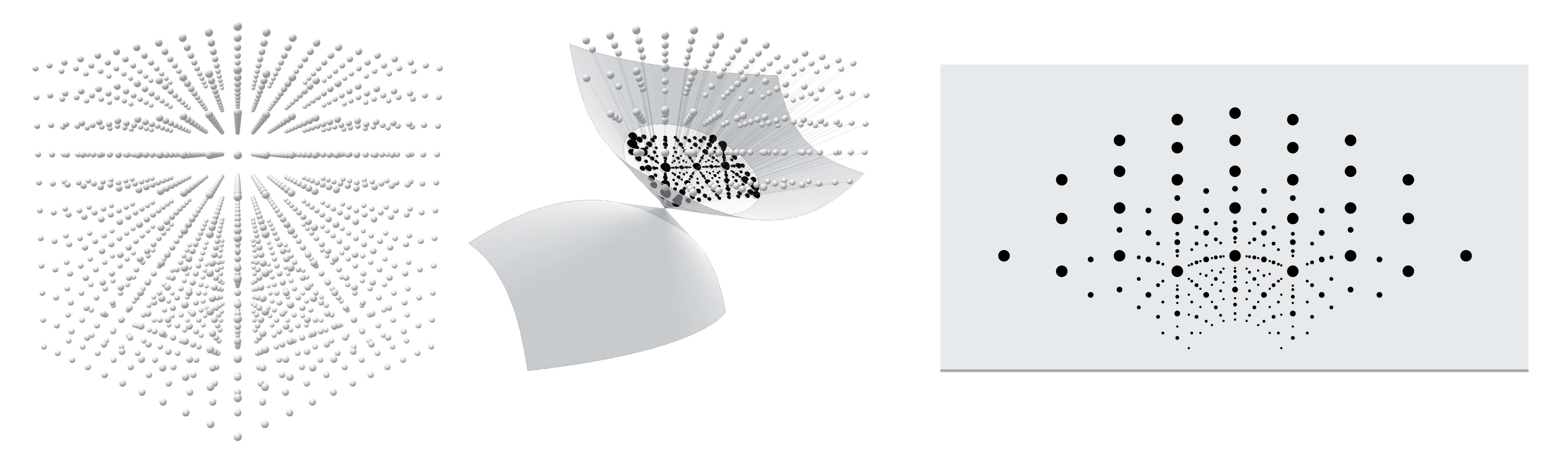
Quadratic Coefficient Space

\[\text{Coefficient space} %= \{ [a:b:c] : a,b,c \in \RR,\; b^2 < 4ac \} = \{ ax^2 + bx + c : a,b,c \in \RR \} \sim \RR^3 \]

\[\text{Quadratic algebraics} = \{ ax^2 + bx + c : a,b,c \in \ZZ \} \sim \ZZ^3 \text{(a 3D lattice)}\]

Quadratic Coefficient Space and the discriminant locus \(b^2 - 4ac\)

\[\text{Cone of imaginary quadratics} %= \{ [a:b:c] : a,b,c \in \RR,\; b^2 < 4ac \} = \{ ax^2 + bx + c : a,b,c \in \RR, \; b^2 < 4ac \} \]

\[\text{Imaginary quadratic algebraics} = \{ ax^2 + bx + c : a,b,c \in \ZZ, \; b^2 - 4ac \} \]

Quadratic Coefficient Space and the discriminant locus \(b^2 - 4ac\)

Klein projective model of hyperbolic space

Hyperbolic isometry

The Coefficients-to-Roots Map

\[\begin{aligned} \mathcal{R} &: \text{Coefficients} \to \text{Roots} \\ \mathcal{R} &: \{ [a:b:c] : b^2 < 4ac \} \to \{ \{x \pm iy\} : x,y \in \RR,\; y > 0 \} \\ \mathcal{R} &: [a:b:c] \mapsto \left\{ \frac{-b \pm i\sqrt{4ac - b^2}}{2a} \right\}. \end{aligned}\]

Diophantine approximation in the reals

Disks of radius \(\sim \frac{1}{20q^2}\):

Rationals repel: \(\left|\dfrac{a}{b} - \dfrac{c}{d}\right| \ge \dfrac{1}{bd}\)

Diophantine approximation in the reals

Disks of radius \(1/q^2\):

Dirichlet’s Theorem: For any \(\alpha \in \RR\), \(\alpha\) is irrational if and only if there exist infinitely many distinct \(p/q \in \QQ\) such that \(\left|\alpha - \dfrac{p}{q}\right| < \dfrac{1}{q^2}\).

Diophantine approximation in the reals

Disks of radius \(1/q^2\):

Roth’s Theorem: Let \(\varepsilon > 0\). For any \(\alpha \in \RR\) algebraic of degree \(\ge 2\), there exist only finitely many distinct \(p/q \in \QQ\) such that \(\left|\alpha - \dfrac{p}{q}\right| < \dfrac{1}{q^{2+\varepsilon}}\).

Question: how well can we approximate a complex number by quadratics?

Arithmetic complexity

Of a root \(\alpha\) or its minimal polynomial \[f_\alpha = a_d x^d + \cdots + a_1 x + a_0 \in \ZZ[x],\quad \gcd(a_i) = 1\]

Naïve height: \(H(f_\alpha) = \max_{0 \le i \le d} |a_i|\).

Arithmetic complexity

Of a root \(\alpha\) or its minimal polynomial \[f_\alpha = a_d x^d + \cdots + a_1 x + a_0 \in \ZZ[x],\quad \gcd(a_i) = 1\]

Naïve height: \(H(f_\alpha) = \max_{0 \le i \le d} |a_i|\).

In our pictures, we have used discriminant \[\Delta_f = a_d^{2d-2} \prod_{i<j} (\alpha_i - \alpha_j)^2.\]

Arithmetic complexity: discriminant

Arithmetic complexity: naïve height

\(\operatorname{PSL}(2;\mathbb{Z})\)-action (quadratics)

On the upper half plane: Möbius transformations on roots

On coefficient space: a \(\PSL(3;\ZZ)\) representation

The quadratic starscape is periodic under \(\PSL(2;\ZZ)\).

Approximation of complex numbers by algebraic numbers of degree \(d\)

Koksma defines \[k_d(\alpha) := \sup\left\{ k : \exists \text{ $\infty$-ly many algebraic } \beta \text{ of degree } \le d,\; |\alpha - \beta| < \frac{1}{H(f_\beta)^k} \right\}.\]

Dirichlet:

  • \(k_1(\alpha) \le 2\) for \(\alpha \in \QQ\);
  • \(k_1(\alpha) \ge 2\) for \(\alpha \in \RR \setminus \QQ\).

Sprindžuk: \(k_1(\alpha) = 2\) for almost all \(\alpha \in \RR\).

Roth: \(k_1(\alpha) = 2\) for algebraic \(\alpha \in \RR\).

Approximation of complex numbers by algebraic numbers of degree \(d\)

Koksma defines \[k_d(\alpha) := \sup\left\{ k : \exists \text{ $\infty$-ly many algebraic } \beta \text{ of degree } \le d,\; |\alpha - \beta| < \frac{1}{H(f_\beta)^k} \right\}.\]

Sprindžuk:

  • For almost all \(\alpha \in \RR\), \(k_d(\alpha) = d + 1\);
  • For almost all \(\alpha \in \CC \setminus \RR\), \(k_d(\alpha) = (d+1)/2\).

Bugeaud and Evertse

Theorem (Bugeaud–Evertse, 2009)

For algebraic \(\alpha \in \CC \setminus \RR\), \[k_d(\alpha) = \begin{cases} (d+1)/2 \text{ or } (d+2)/2 & \deg(\alpha) \ge d + 2 \text{ and } d \text{ is even} \\ \min\{\deg(\alpha)/2,\, (d+1)/2\} & \text{otherwise.} \end{cases}\]

For \(d = 2\), \(\deg(\alpha) > 2\):

\[k_d(\alpha) = \begin{cases} 2 & 1,\; \alpha\overline{\alpha},\; \alpha + \overline{\alpha} \text{ are } \QQ\text{-linearly dependent} \\ 3/2 & \text{otherwise.} \end{cases}\]

Bugeaud and Evertse

Theorem (Bugeaud–Evertse, 2009)

For algebraic \(\alpha \in \CC \setminus \RR\), \[k_d(\alpha) = \begin{cases} (d+1)/2 \text{ or } (d+2)/2 & \deg(\alpha) \ge d + 2 \text{ and } d \text{ is even} \\ \min\{\deg(\alpha)/2,\, (d+1)/2\} & \text{otherwise.} \end{cases}\]

For \(d = 2\), \(\deg(\alpha) > 2\):

\[k_d(\alpha) = \begin{cases} 2 & 1,\; \alpha\overline{\alpha},\; \alpha + \overline{\alpha} \text{ are } \QQ\text{-linearly dependent} \\ 3/2 & \text{otherwise.} \end{cases}\]

Geometrically,

\(1,\; \alpha\overline{\alpha},\; \alpha + \overline{\alpha}\) are \(\QQ\)-linearly dependent if and only if \(\alpha\) lies on a rational geodesic.

Quartics approximated by quadratics

Quadratic Dirichlet’s Theorem

Rational geodesic = image of rational plane from coefficient space

Theorem (Harriss-S.-Trettel)

Let \(\alpha \in \CC \setminus \RR\) not be quadratic irrational, but lying on a rational geodesic. Then there exists \(K_\alpha > 0\), depending on the \(\PSL(2;\ZZ)\) orbit of \(\alpha\), so that there are infinitely many quadratic irrational \(\beta\) on that geodesic with \[d_\text{hyp}(\alpha, \beta) \le \operatorname{acosh}\!\left( 1 + \frac{K_\alpha}{|\Delta_\beta|^2} \right).\]

Without the geodesic condition, for any \(K > 0\), there are infinitely many quadratic irrational \(\beta\) with \[d_\text{hyp}(\alpha, \beta) \le \operatorname{acosh}\!\left( 1 + \frac{K}{|\Delta_\beta|^{3/2}} \right).\]

Cubic irrationals, sized by inverse discriminant

Cubic irrationals, sized by inverse discriminant (detail)
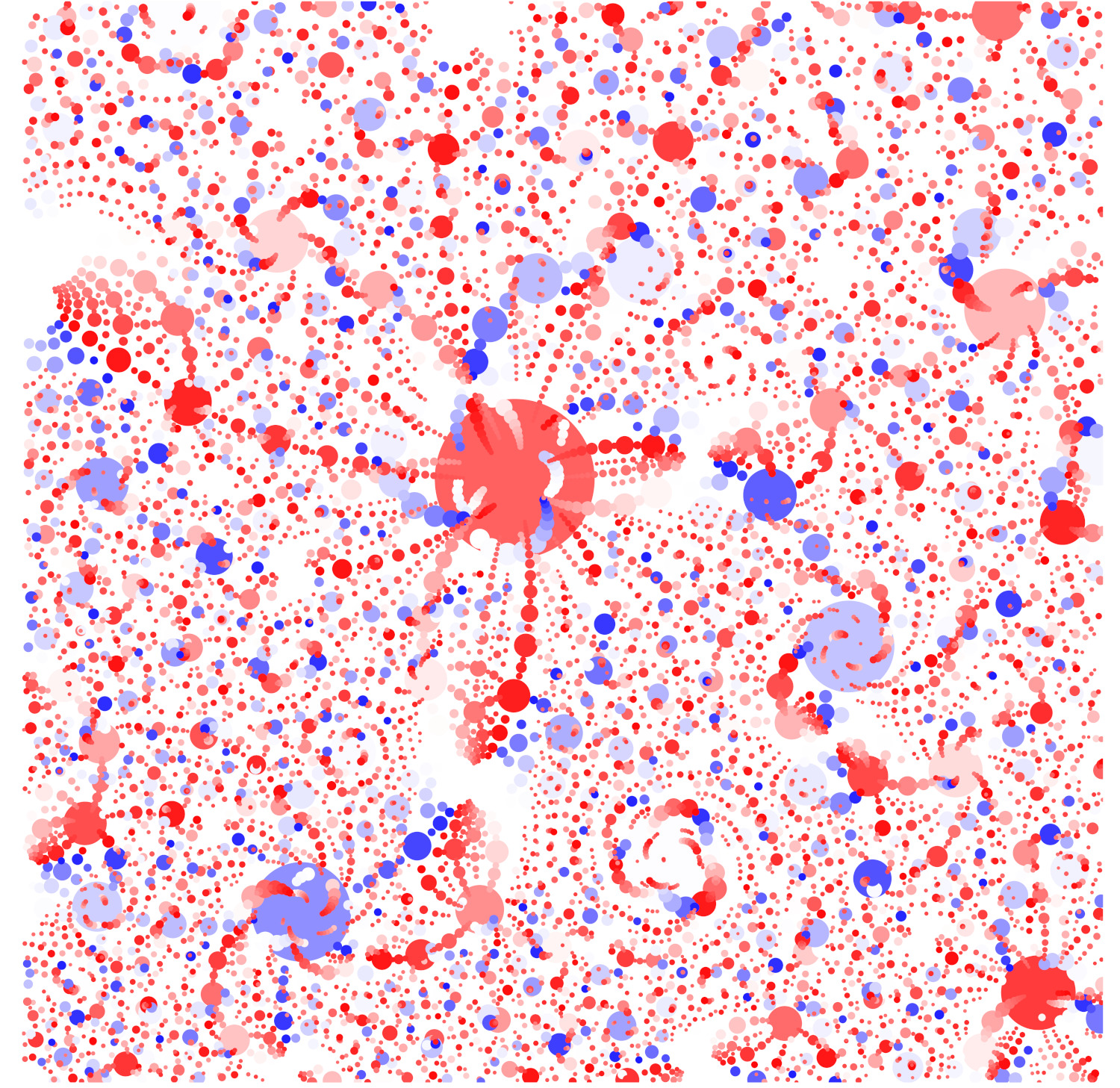
Cubics in 3d
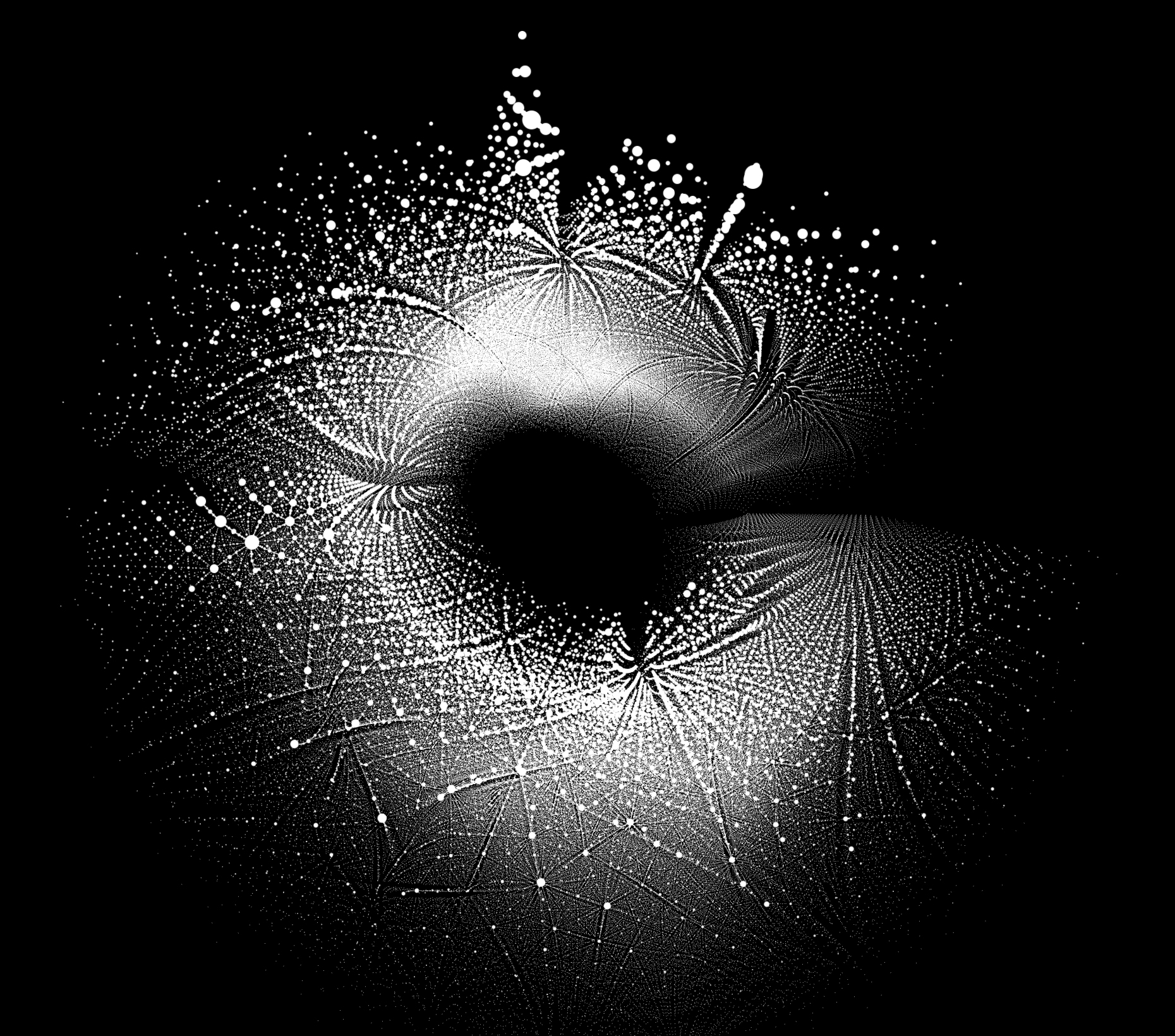
Visualization software SLView by Emily Dumas.

Roots of \(ax^3 + bx^2 + ax + c\) forming a Möbius strip

Visualization software SLView by Emily Dumas.

\(ax^3 + bx + c = 0\)

\(ax^3 + cx^2 + bx + c = 0\)

Lines in the cubic starscape \(ax^3 + cx^2 + bx + c\)

\(ax^4 + x^3 + bx^2 + bx + c = 0\) (coloured by degree)

\(ax^4 + bx^3 + cx^2 + bx + a = 0\)

\(ax^5 + bx^3 + cx^2 + bx + a = 0\)

\(ax^4 + bx^2 + bx + c = 0\) (coloured by sign real roots)

Farey Structure for Approximation by Quadratics?

Quintics by Dorfsman-Hopkins and Xu

Quartics with Rigidity by Dorfsman-Hopkins and Xu
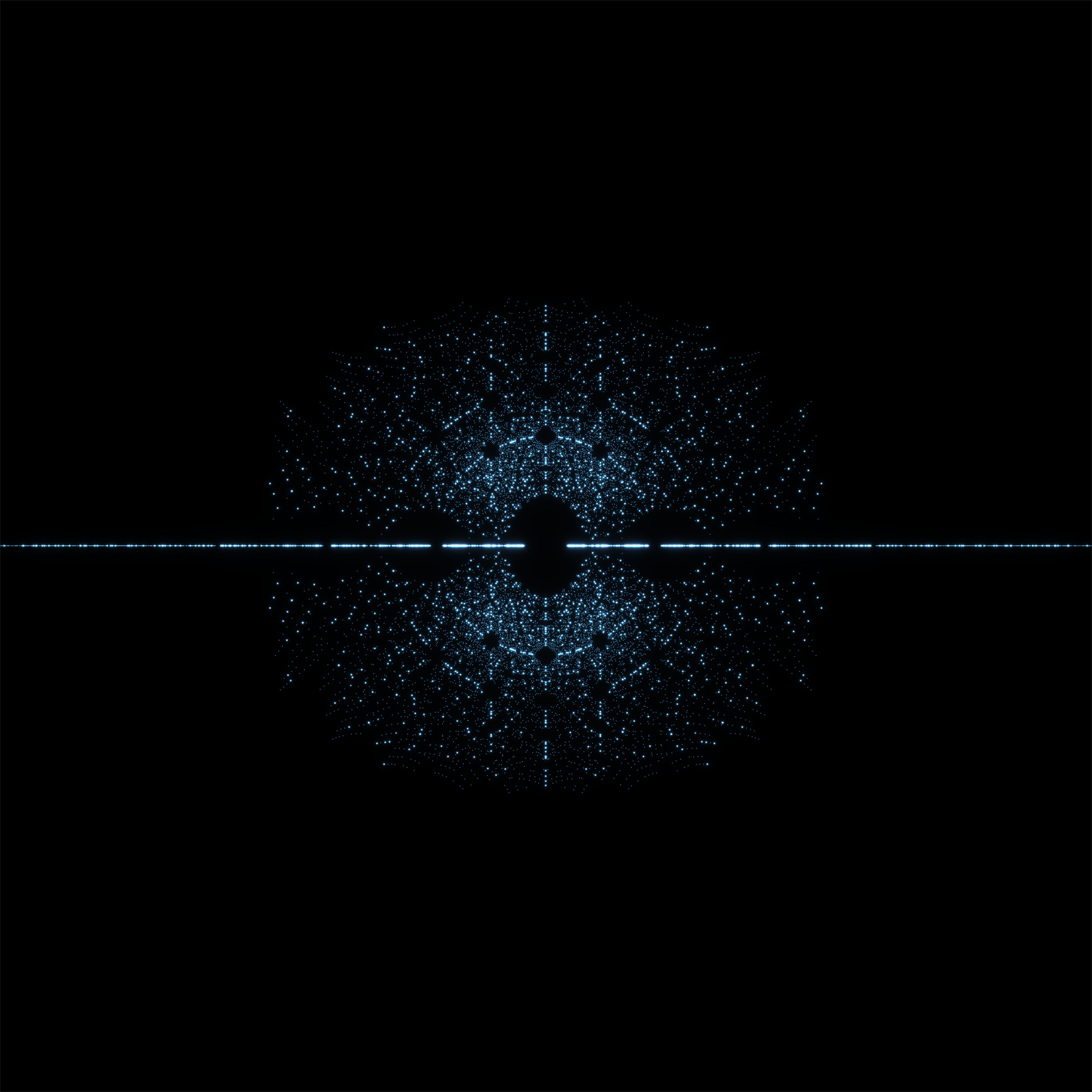
The Farey tesselation is … a picture of \(\SL(2,\ZZ)\)
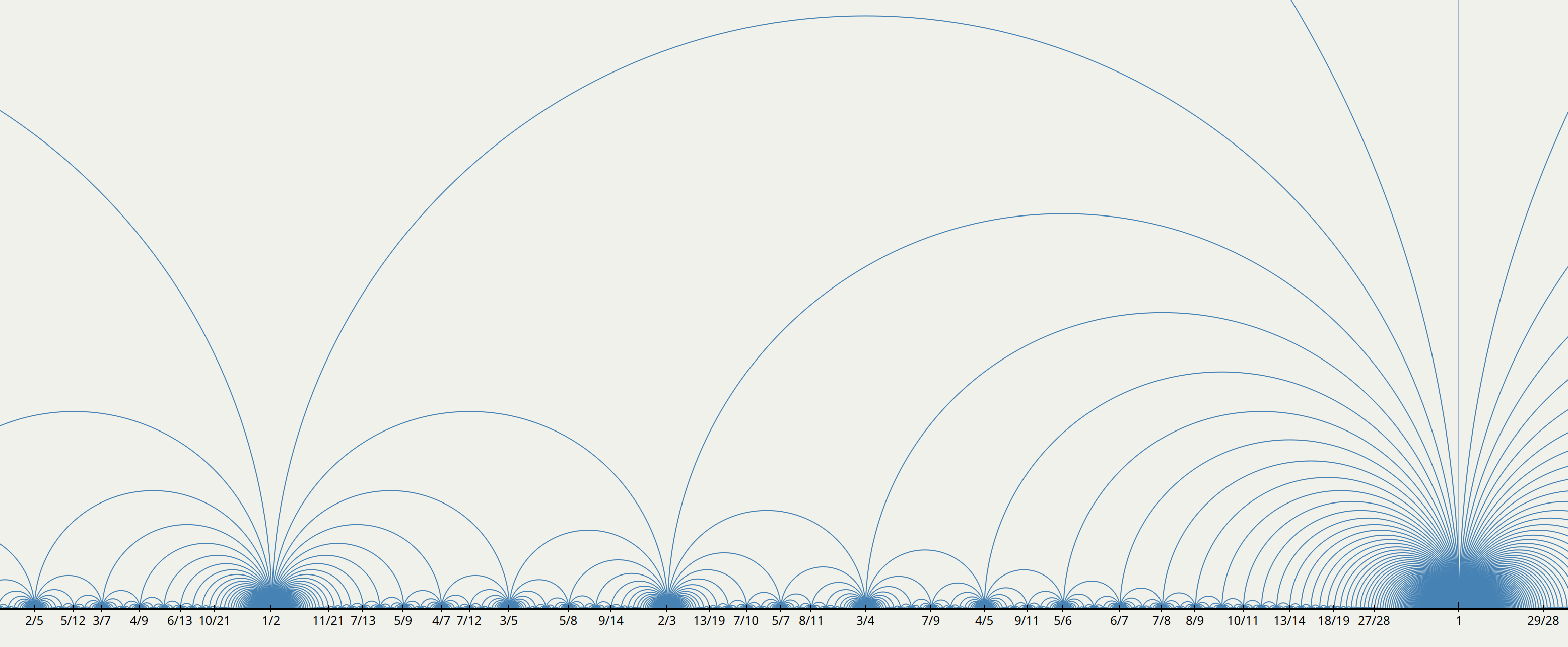
Geodesic \(a/b\) to \(c/d\) \(\Longleftrightarrow ad-bc = 1\)

The Farey tesselation is … a picture of \(\SL(2,\ZZ)\)

The orbit of the geodesic \(0\) to \(\infty\) under \(\SL(2,\ZZ)\)

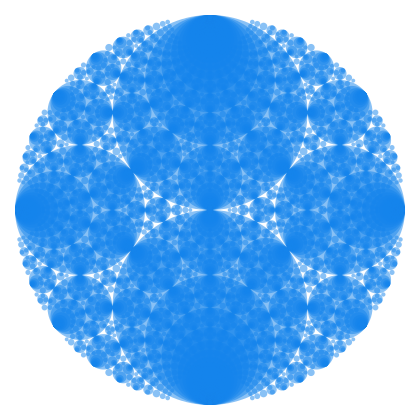
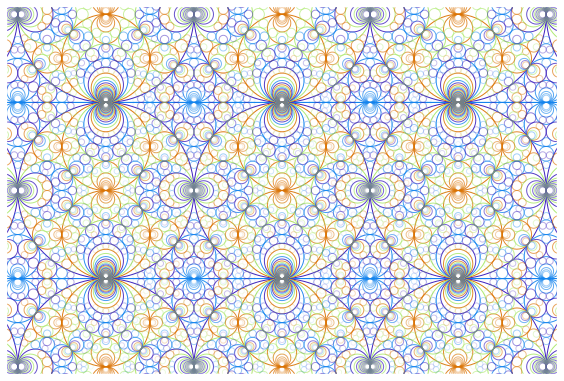
Schmidt arrangement of \(\QQ(i)\)
?

Schmidt arrangement of \(\QQ(i)\)

orbit of real line under \(\PSL_2(\ZZ[i])\)

Schmidt arrangement of \(\QQ(\sqrt{-2})\)
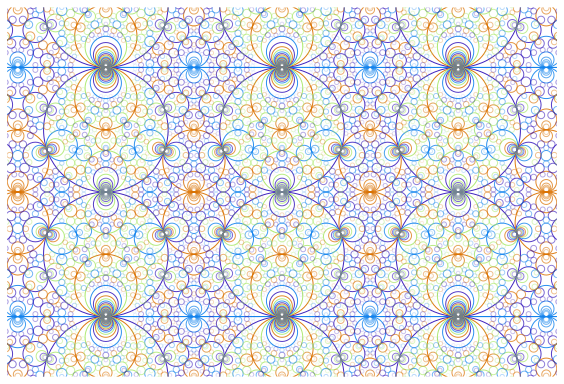
orbit of real line under \(\PSL_2(\ZZ[\sqrt{-2}])\)

Schmidt arrangement of \(\QQ(\sqrt{-7})\)

orbit of real line under \(\PSL_2(\ZZ[\tfrac{1+\sqrt{-7}}{2}])\)

Schmidt arrangement of \(\QQ(\sqrt{-11})\)
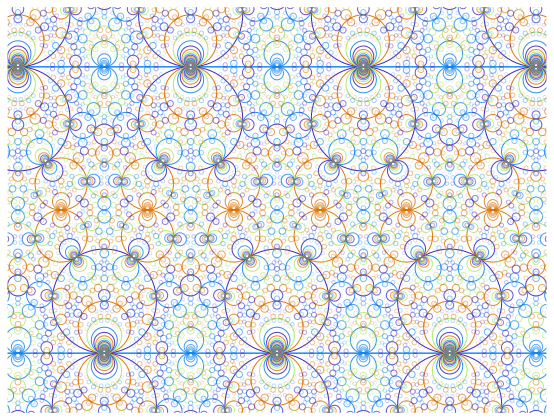
orbit of real line under \(\PSL_2(\ZZ[\tfrac{1+\sqrt{-11}}{2}])\)

Schmidt arrangement of \(\QQ(\sqrt{-6})\)
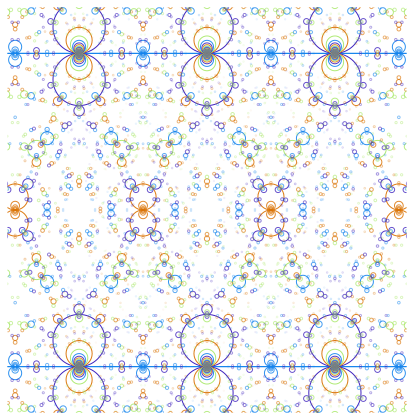
orbit of real line under \(\PSL_2(\ZZ[\sqrt{-6}])\)

Schmidt arrangement of \(\QQ(\sqrt{-15})\)
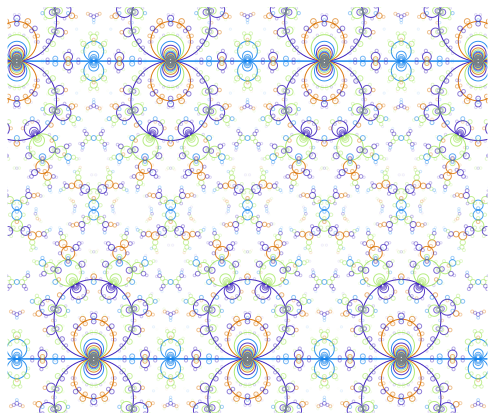
orbit of real line under \(\PSL_2(\ZZ[\tfrac{1+\sqrt{-15}}{2}])\)

Illustrating the Arithmetic of Imaginary Quadratic Fields

tangency points = rational points of trivial class

\[\alpha/\beta \in K \text{ such that } (\alpha,\beta) \text{ is a principal ideal}\]

size of the pencil \(= 1/N(\beta)\)

Number theory

\(K\) — a number field (imaginary quadratic)

\(\mathcal{O}_K\) — ring of integers (\(\ZZ[\sqrt{d}]\) or \(\ZZ[\tfrac{1+\sqrt{d}}{2}]\))

\(\mathcal{O}_f = \ZZ + f\mathcal{O}_K\) — suborder of conductor \(f\)

\[\operatorname{Cl}(\mathcal{O}_K) = \left\{ I \subset \mathcal{O}_K \text{ ideal} \right\} / \sim\]

where \[I \sim J \Leftrightarrow \alpha I = J,\; \alpha \in K\]

Group with identity \(\mathcal{O}_K = (1)\).

E.g.: \((2,1+\sqrt{-5}) \sim (2(1-\sqrt{-5}),6) \sim (3,1-\sqrt{-5})\) non-trivial in \(\ZZ[\sqrt{-5}]\).

\(\operatorname{Cl}(\mathcal{O}_f)\) similar (using only ideals coprime to \(f\))
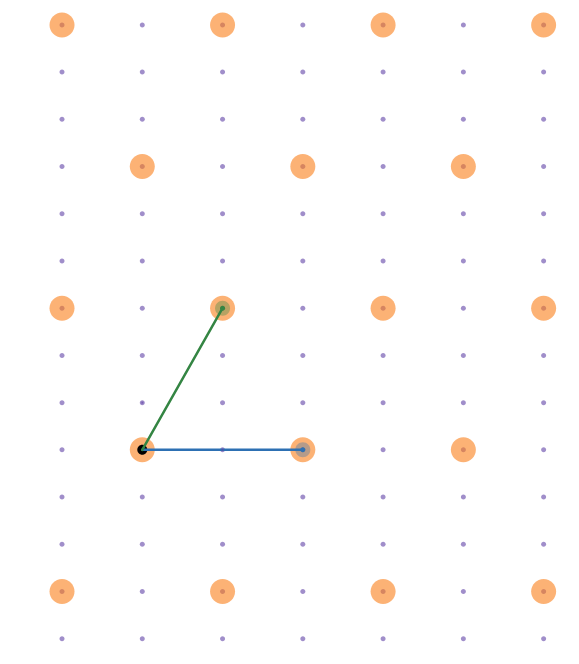
Illustrating the Arithmetic of Imaginary Quadratic Fields
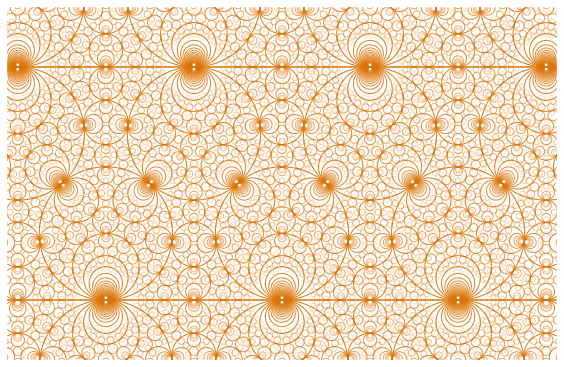
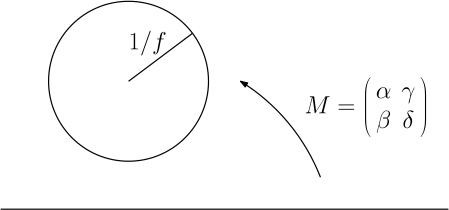
circles = ideal classes of orders (that are trivial when extended to maximal order)

\[\begin{pmatrix} \alpha & \gamma \\ \beta & \delta \end{pmatrix} \quad\longleftrightarrow\quad \beta\ZZ + \delta\ZZ\]

curvature of circle = conductor of the order

Illustrating the Arithmetic of Imaginary Quadratic Fields
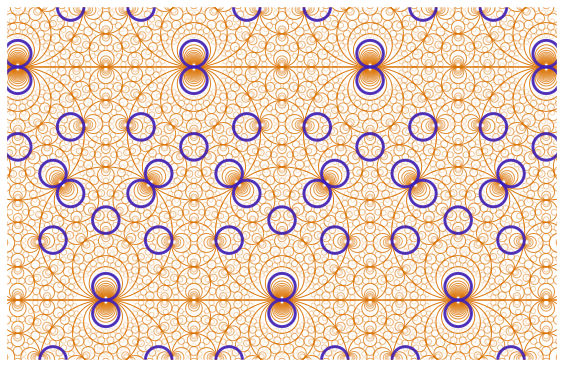
circles = ideal classes of orders (that are trivial when extended to maximal order)

\[\begin{pmatrix} \alpha & \gamma \\ \beta & \delta \end{pmatrix} \quad\longleftrightarrow\quad \beta\ZZ + \delta\ZZ\]

curvature of circle = conductor of the order

The Farey Tesselation is … a Cayley graph

Stepping from geodesic to geodesic = multiplication by an elementary matrix \[ \begin{pmatrix} 1 & 0 \\ 1 & 1 \end{pmatrix}, \quad \begin{pmatrix} 1 & 1 \\ 0 & 1 \end{pmatrix} \]

The Euclidean algorithm = computing a word in \(\SL(2,\ZZ)\) = travelling from \(a/b\) to \(1/0\)

Illustrating the Arithmetic of Imaginary Quadratic Fields

Euclideanity = tangency (or topological) connectedness

Illustrating the Arithmetic of Imaginary Quadratic Fields

Euclideanity = tangency (or topological) connectedness

The Farey Tessellation is … Continued Fractions

\[\begin{pmatrix} 355 \\ 113 \end{pmatrix} = L^3 R^7 L^{15} R^1 \begin{pmatrix} 1 \\ 0 \end{pmatrix} = \begin{pmatrix} 1 & 1 \\ 0 & 1 \end{pmatrix}^3 \begin{pmatrix} 1 & 0 \\ 1 & 1 \end{pmatrix}^{7} \begin{pmatrix} 1 & 1 \\ 0 & 1 \end{pmatrix}^{15} \begin{pmatrix} 1 & 0 \\ 1 & 1 \end{pmatrix}^1 \begin{pmatrix} 1 \\ 0 \end{pmatrix}\]

\[\frac{355}{113} = 3+\cfrac{1}{7 +\cfrac{1}{15 +\cfrac{1}{1}}}\]

Continued Fractions (Series)

\[\begin{aligned} \begin{pmatrix} 335 \\ 113 \end{pmatrix} = L^3 R^7 L^{15} R^1 \begin{pmatrix} 1 \\ 0 \end{pmatrix} &= \begin{pmatrix} 1 & 1 \\ 0 & 1 \end{pmatrix}^3 \begin{pmatrix} 1 & 0 \\ 1 & 1 \end{pmatrix}^{7} \begin{pmatrix} 1 & 1 \\ 0 & 1 \end{pmatrix}^{15} \begin{pmatrix} 1 & 0 \\ 1 & 1 \end{pmatrix}^1 \begin{pmatrix} 1 \\ 0 \end{pmatrix} \\ &= \begin{pmatrix} 3 & 1 \\ 1 & 0 \end{pmatrix} \begin{pmatrix} 7 & 1 \\ 1 & 0 \end{pmatrix} \begin{pmatrix} 15 & 1 \\ 1 & 0 \end{pmatrix} \begin{pmatrix} 1 & 1 \\ 1 & 0 \end{pmatrix} \begin{pmatrix} 1 \\ 0 \end{pmatrix} \end{aligned}\]

Continued Fractions (Series)

Continued fraction semigroup:

\[\SL(2,\ZZ)^{\ge 0} = \langle L, R \rangle^+ = \left\{ \begin{pmatrix} a & b \\ c & d \end{pmatrix} \in \PSL_2(\ZZ) : a,b,c,d \ge 0 \right\}\]

Zaremba’s Conjecture

Let \(A \subseteq \NN\) be a finite alphabet.

\[Z_A := \left\{ q \in \NN : \substack{ \exists p \in \NN, \\ p/q \text{ has continued fraction expansion} \\ \text{using only coefficients from } A} \right\}\]

Conjecture (Zaremba)

Let \(A = \{1,2,3,4,5\}\). Then \(Z_A = \NN\).

\[Z_A = \left\{ q \in \ZZ : \exists p \in \NN,\; \smcol{p}{q} \in \Gamma_A \cdot \smcol{1}{0} \right\},\quad \Gamma_A := \left\langle \begin{pmatrix} a & 1 \\ 1 & 0 \end{pmatrix} : a \in A \right\rangle^+.\]

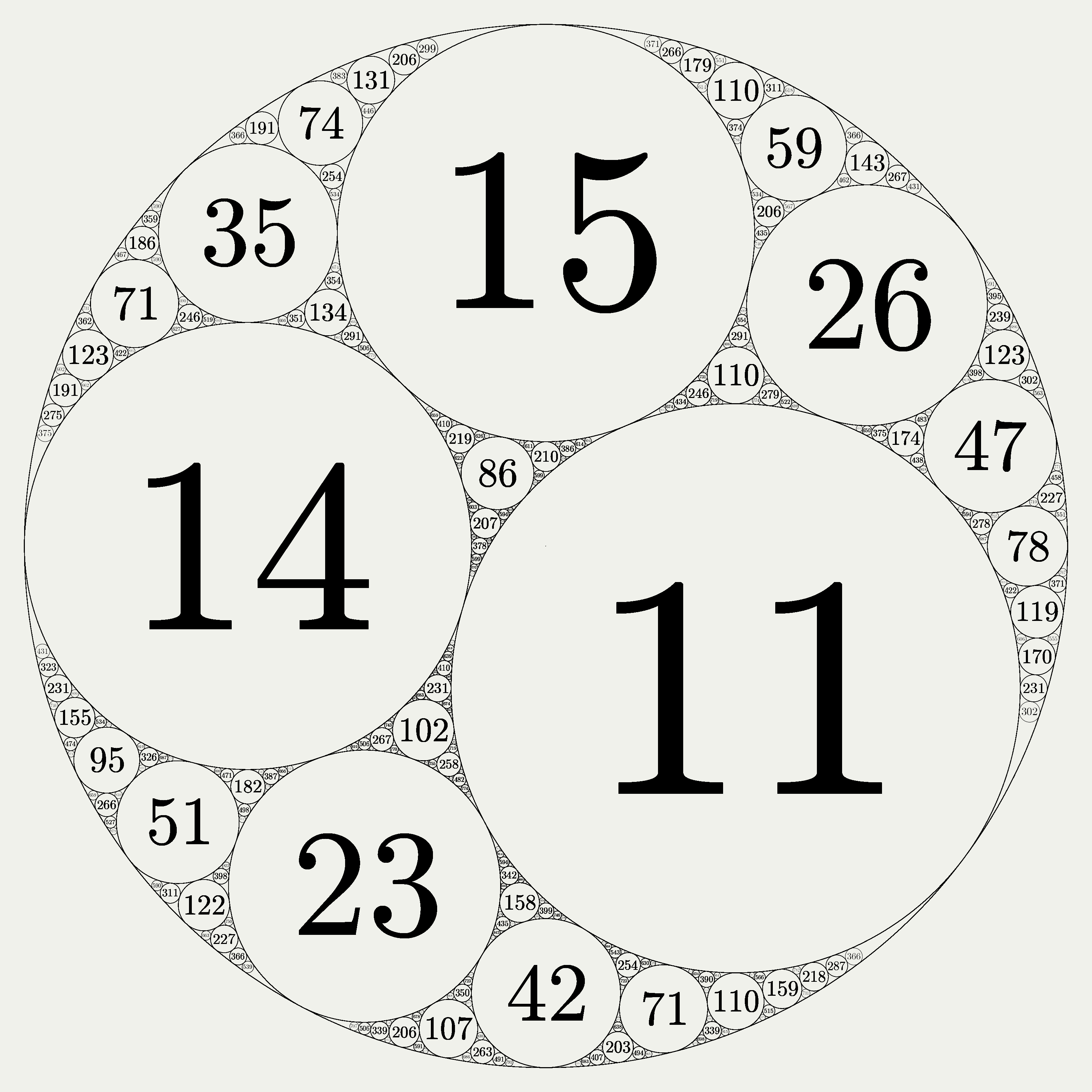
The Farey Tessellation is … the start of an Apollonian circle packing

The Farey Tessellation is … the start of an Apollonian circle packing

The Farey Tessellation is … the start of an Apollonian circle packing

The Farey Tessellation is … the start of an Apollonian circle packing

Continued fractions: \(\QQ\) and \(\QQ(i)\)
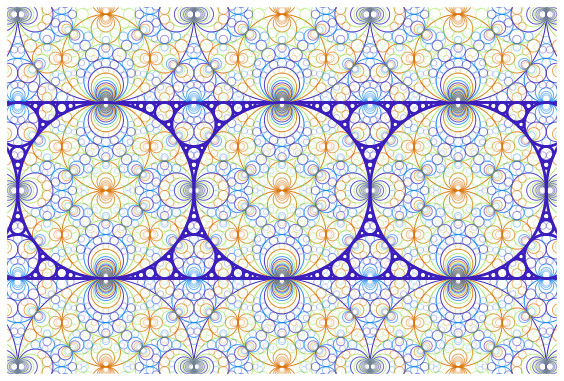
     

Farey subdivision            Schmidt arrangement

\(\SL_2(\ZZ)^{\ge 0}\)              \(\SL_2(\ZZ[i])\)

See Schmidt, Chaubey–Fuchs–Hines–S., Martin.

Apollonian group (Hirst)

Acting on Descartes quadruples of curvatures:

  (4 swaps)

\[\cpack = \left\langle S_1, S_2, S_3, S_4 : S_i^2 = 1 \right\rangle \]

A theorem of Elizabeth and Descartes

Curvatures \(a\), \(b\), \(c\), \(d\) of four mutually tangent circles (a Descartes quadruple) satisfy \[\color{#1584ed}{2(a^2 + b^2 + c^2 + d^2) = (a+b+c+d)^2}.\]

Given \(a\), \(b\), \(c\), there are two possibilities \(d\) and \(d'\) satisfying \[\color{#1584ed}{d + d' = 2(a+b+c)}.\]

Therefore \[\color{#1584ed}{a,b,c,d \in \ZZ} \quad\implies\quad \color{#1584ed}{\text{everything} \in \ZZ}.\]

Apollonian Curvatures

Question

What curvatures appear in a fixed primitive Apollonian circle packing?

Thank you!

Growth rates of orbits

\[\#\{ C : \operatorname{curv}(C) < X \} \sim c_A X^{1.30568\ldots},\quad 1.30568\ldots = \text{Hausdorff dim}.\]

So that multiplicities, on average, are around \(X^{0.3}\).

(Boyd, McMullen, Kontorovich–Oh)

\[\#\{ \text{denominators} \le N \} \sim C_A N^{2\delta_A},\quad \delta_A = \text{Hausdorff dimension}.\]

\[\delta_A > 1/2 \quad\Longrightarrow\quad \text{average multiplicity} \to \infty.\]

Some examples of Zaremba alphabets:

  • \(A = \{1, 2, 3, 4, 5\}\): \(\delta_A \approx 0.8368\)
  • \(A = \{1, 2, 3, 4\}\): \(\delta_A \approx 0.7889\)
  • \(A = \{1, 2, 3\}\): \(\delta_A \approx 0.7057\)
  • \(A = \{1, 2\}\): \(\delta_A \approx 0.5313\)

Curvatures modulo \(5\)

Curvatures modulo \(3\)

Congruence obstructions (local obstructions)

Modulo 24, certain residue classes in an ACP are missed:

Type Allowed residues
\((6,1)\) \(0, 1, 4, 9, 12, 16\)
\((6,5)\) \(0, 5, 8, 12, 20, 21\)
\((6,13)\) \(0, 4, 12, 13, 16, 21\)
\((6,17)\) \(0, 8, 9, 12, 17, 20\)
\((8,7)\) \(3, 6, 7, 10, 15, 18, 19, 22\)
\((8,11)\) \(2, 3, 6, 11, 14, 15, 18, 23\)

The Zaremba alphabet \(A = \{2, 4, 6, 8, 10\}\): \(\delta_A \approx 0.5174\) misses \(3 \pmod{4}\) (Bourgain–Kontorovich).

History for ACP

Conjecture: \[\mathcal{K}(N) := \{ n \le N : n \text{ is a curvature} \} = kN + O(1)\]

Here, \(k = \dfrac{\#\text{admissible curvatures modulo } 24}{24}\).

  • Graham–Lagarias–Mallows–Wilks–Yan (2003): \(\mathcal{K}(N) \gg \sqrt{N}\).
  • Sarnak (2007): \(\mathcal{K}(N) \gg \frac{N}{\sqrt{\log N}}\).
  • Bourgain–Fuchs (2011): \(\mathcal{K}(N) \gg N\) (positive density).
  • Bourgain–Kontorovich (2014): \(\exists \eta>0,\; \mathcal{K}(N) = kN + O(N^{1-\eta})\) (density one).
  • Zhang, Fuchs–S.–Zhang (2019): \(\exists \eta>0,\; \mathcal{K}(N) = kN + O(N^{1-\eta})\) for a larger class of packings.

Tool: quadratic forms (Sarnak, Graham–Lagarias–Mallows–Wilks–Yan)

There is a bijection: \[\left\{ \substack{ \text{curvatures of circles tangent} \\ \text{to fixed mother circle } C \text{ of curvature } a} \right\} \leftrightarrow \{ f_C(x,y) - a : \gcd(x,y) = 1 \}\]

where \(f_C\) is a primitive integral binary quadratic form of discriminant \(-4a^2\) associated to the “mother circle”.

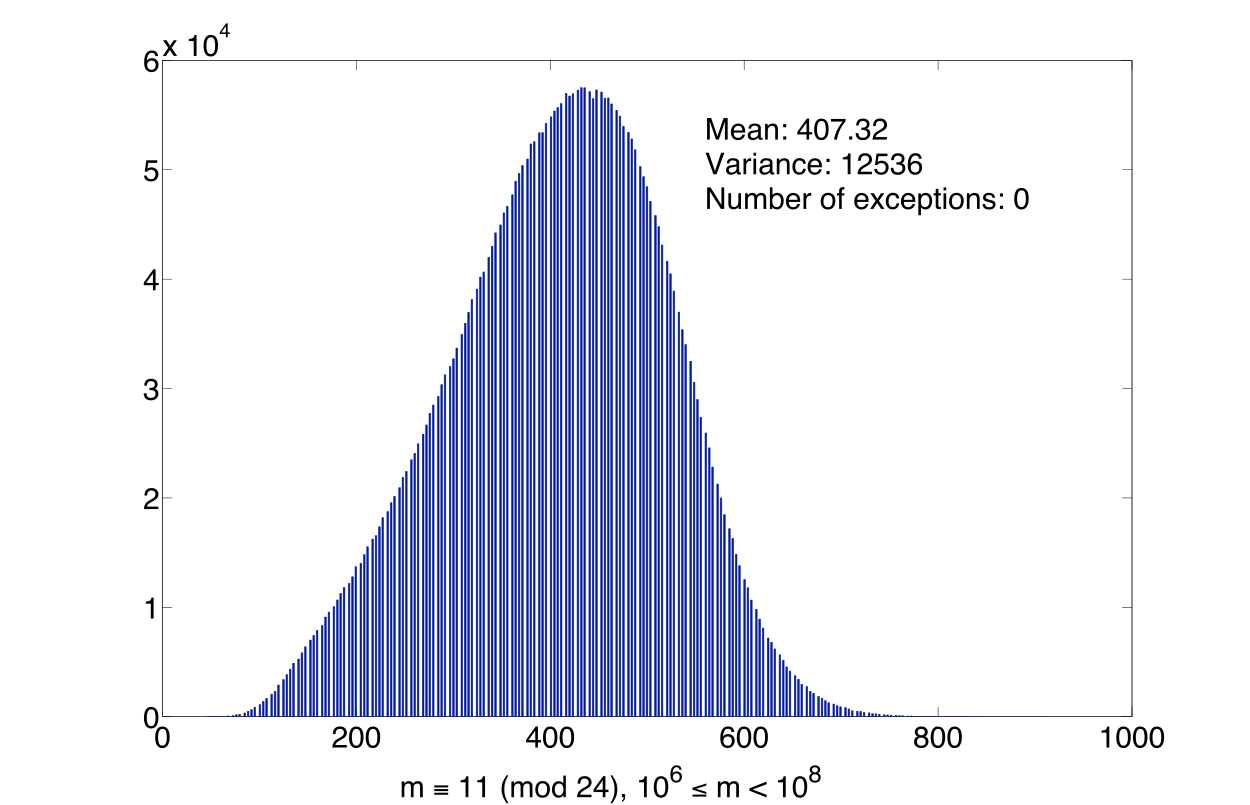
Computational Evidence (Fuchs–Sanden)

Computed curvatures up to:

\(10^8\) for \((-1, 2, 2, 3)\)

\(5\cdot 10^8\) for \((-11, 21, 24, 28)\)

and observed that the multiplicity of a curvature was tending to increase.
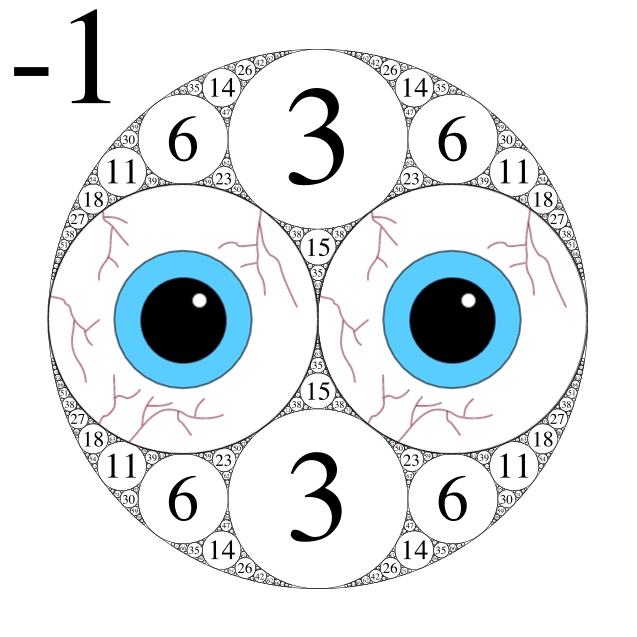
  

Images from Fuchs, Sanden.

Computational Evidence

Curvature \(c\) is missing in \(\cpack\) if curvatures \(\equiv c \pmod{24}\) appear in \(\cpack\) but \(c\) does not.

For \((-11, 21, 24, 28)\), there were still a small number (up to \(0.013\%\)) of missing curvatures in the range \((4\cdot 10^8, 5\cdot 10^8)\) for residue classes \(0, 4, 12, 16 \pmod{24}\).

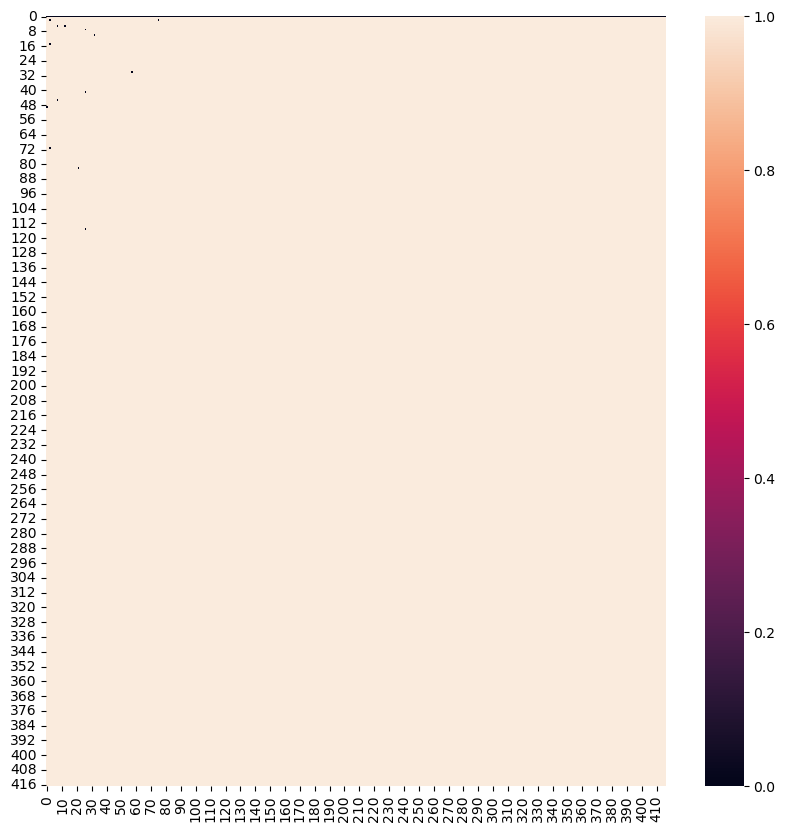
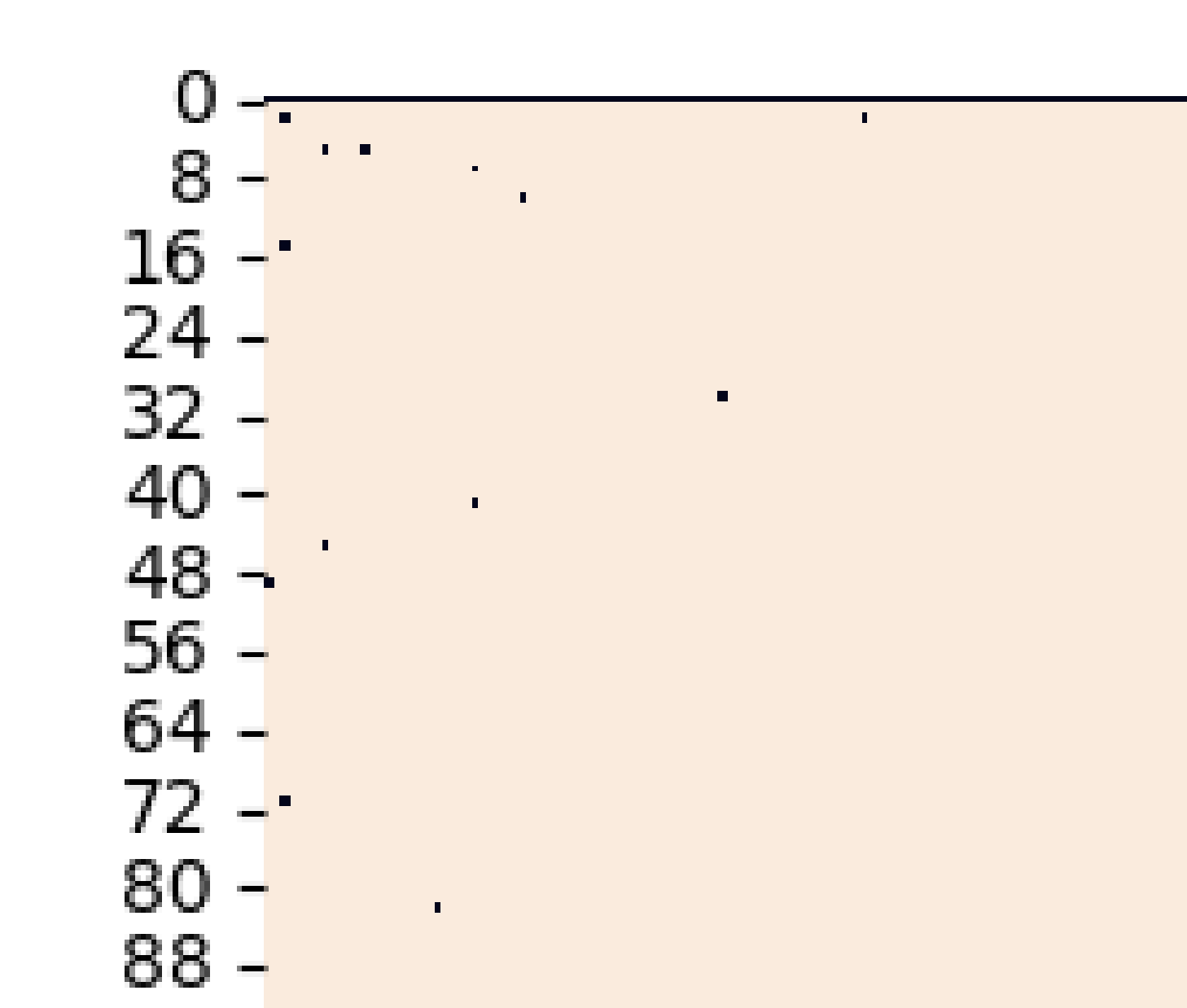
Summer 2023 REU

  • Fix a pair of curvatures, and study what packings contain them.
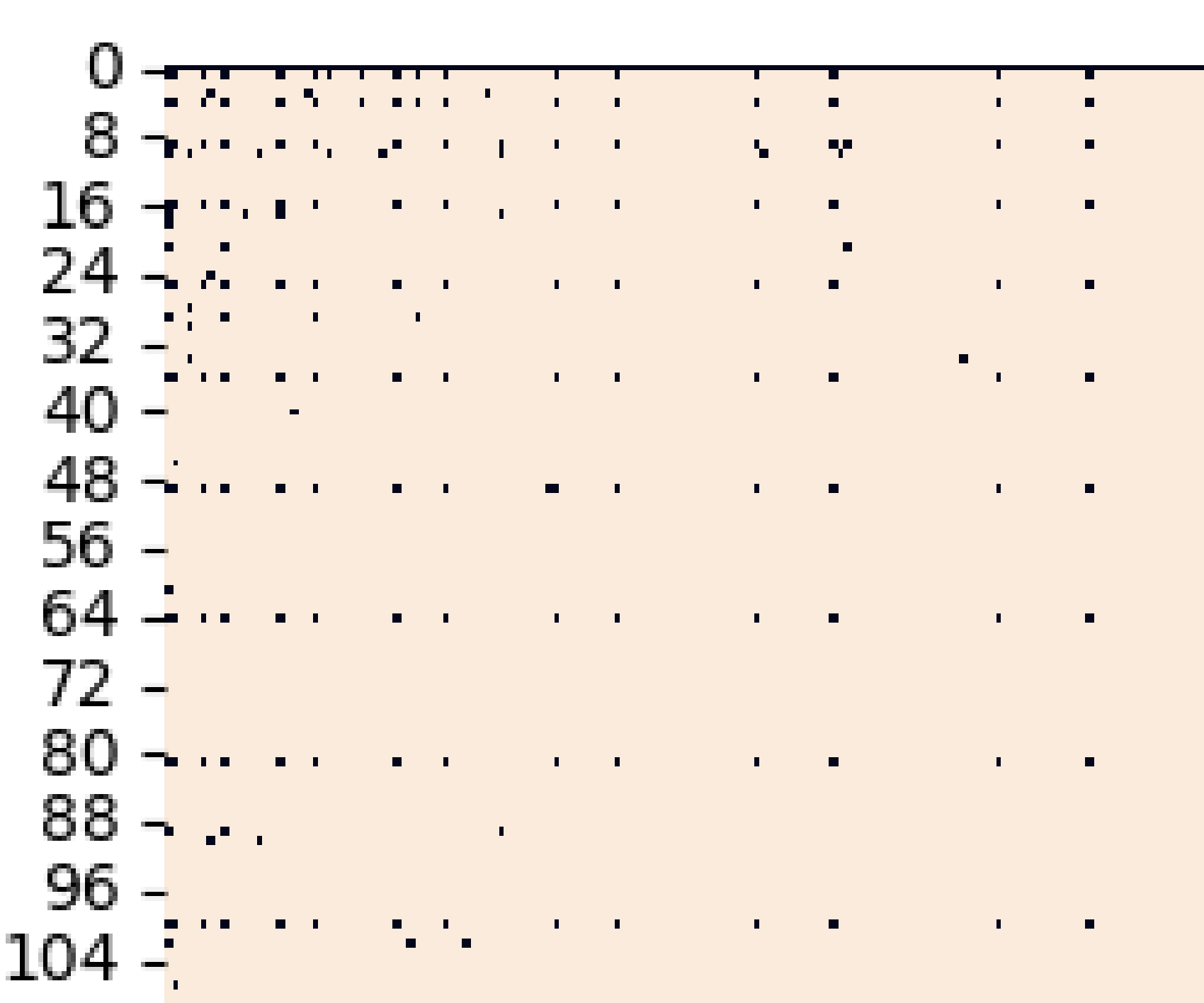
  • Plot: for an admissible pair of residue classes modulo 24, black dot if no packing has that pair.
  • Local-global: finitely many black dots on any row or column.

Typical graph


Residue classes \(0\pmod{24}\) and \(12\pmod{24}\) (Summer Haag)

One weird graph
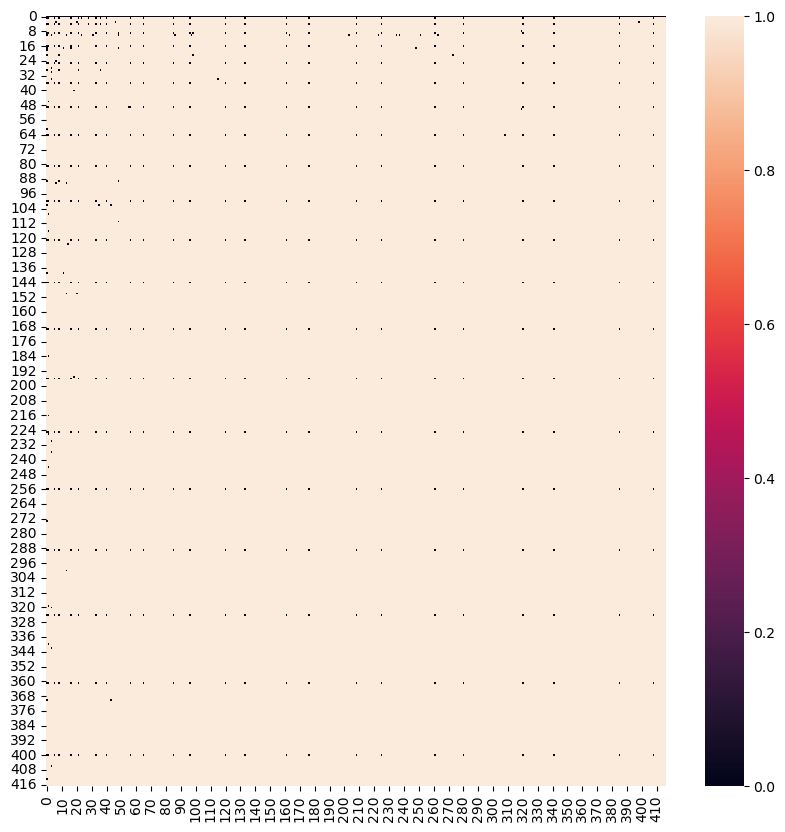
 

Residue classes \(0\pmod{24}\) and \(8\pmod{24}\) (Summer Haag)

Differences between successive missing curvatures
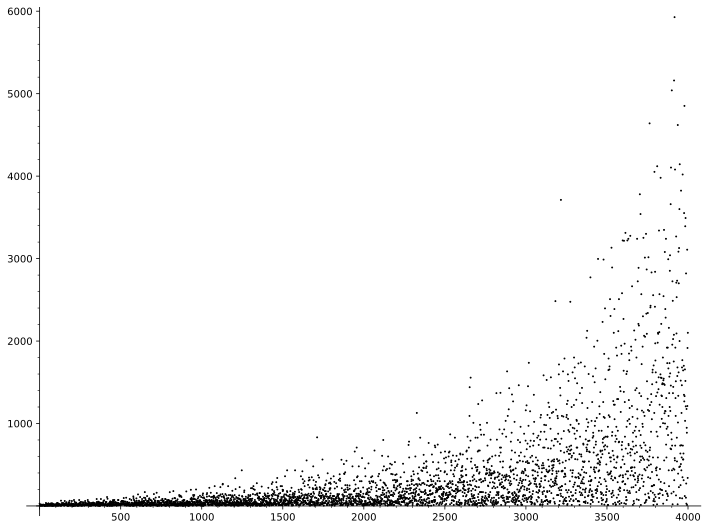
Differences between successive missing curvatures

The conjecture is false

Theorem (Haag–Kertzer–Rickards–S. 2024)

The Apollonian circle packing \(\cpack\) generated by quadruple \((-3,5,8,8)\) has no square curvatures.

Quadratic Reciprocity

Legendre symbol: \[\left( \frac{a}{p} \right) = \begin{cases} 1 & a \text{ is a non-zero square modulo } p \\ -1 & a \text{ is a non-zero nonsquare modulo } p \\ 0 & a \text{ is zero modulo } p. \end{cases}\]

Quadratic reciprocity for odd primes \(p\) and \(q\): \[\left( \frac{p}{q} \right) = (-1)^{\frac{p-1}{2}\frac{q-1}{2}} \left( \frac{q}{p} \right).\]

Generalizes to Kronecker symbol: still, \(-1\) means neither top nor bottom is square!

A circle has a “residuosity”

  1. Fix circle \(\cir\) of curvature \(n\); tangent curvatures \(f_\cir(x,y) - n\) of discriminant \(-4n^2\).
  2. Modulo \(n\) and equivalence, values are \(Ax^2\).
  3. Kronecker symbol \(\left(\frac{Ax^2}{n}\right)\) cannot take both values \(1\) and \(-1\).
  4. Define \(\chi_2(\cir) = 1\) or \(-1\) according to above.
  5. Note: \(\chi_2(\cir) = \left(\frac{a}{n}\right)\) for a curvature \(a\) coprime and tangent to \(\cir\).
  6. Observe: If \(\chi_2(\cir) = -1\), then \(n\) is not square.

A packing has a “residuosity”

  1. Suppose that \(\cir_1, \cir_2 \in \cpack\) are tangent, having non-zero coprime curvatures \(a\) and \(b\) respectively.
  2. Quadratic reciprocity: \[\chi_2(\cir_1)\chi_2(\cir_2) = \dkron{a}{b}\dkron{b}{a} = 1 \quad\Longrightarrow\quad \chi_2(\cir_1) = \chi_2(\cir_2).\]
  3. Any two circles in \(\cpack\) are connected by a path of pairwise coprime curvatures.
  4. So \(\chi_2(\cir)\) is independent of the choice of circle \(\cir\).

There are no squares in the packing

  1. In base quadruple \((-3,5,8,8)\), compute \[\chi_2(\cpack) = \dkron{8}{5} = \dkron{3}{5} = -1.\]
  2. So no circle can have square curvature.

Quartic reciprocity

\(C \longrightarrow [\beta\ZZ + \delta\ZZ] \in \operatorname{Cl}(\mathcal{O}_f)\)

quadratic symbol \(\to\) quartic symbol

value of form \(\to\) element of lattice

Obstructions for types \((x, k, \chi_2(\cpack), \chi_4(\cpack))\)

Type Quadratic Quartic
\((6, 1, 1, 1)\)
\((6, 1, 1, -1)\) \(n^4, 4n^4, 9n^4, 36n^4\)
\((6, 1, -1)\) \(n^2, 2n^2, 3n^2, 6n^2\)
\((6, 5, 1)\) \(2n^2, 3n^2\)
\((6, 5, -1)\) \(n^2, 6n^2\)
\((6, 13, 1)\) \(2n^2, 6n^2\)
\((6, 13, -1)\) \(n^2, 3n^2\)
\((6, 17, 1, 1)\) \(3n^2, 6n^2\) \(9n^4, 36n^4\)
\((6, 17, 1, -1)\) \(3n^2, 6n^2\) \(n^4, 4n^4\)
\((6, 17, -1)\) \(n^2, 2n^2\)
\((8, 7, 1)\) \(3n^2, 6n^2\)
\((8, 7, -1)\) \(2n^2\)
\((8, 11, 1)\)
\((8, 11, -1)\) \(2n^2, 3n^2, 6n^2\)

New conjecture

Sporadic set \(S_\cpack\) of AWOL curvatures: missing but not because of congruence or reciprocity obstructions.

Conjecture (Haag–Kertzer–Rickards–S.)

Let \(\cpack\) be a primitive Apollonian circle packing. Then \(S_\cpack\) is finite.

  • James wrote efficient C/PARI/GP code for \(S_\cpack(N)\) (GitHub).
  • \(10^{10}\) in a few hours; \(10^{12}\) possible.

Reciprocity obstructions in \(\SL(2, \ZZ)^{\ge 0}\) (joint w/ Rickards)

\[\text{subsemigroups of } \SL(2,\ZZ)^{\ge 0} \quad\longleftrightarrow\quad \text{restricted continued fraction expansions}\]

A fascinating subset: \[\Psi := \left\{ \genmtx \in \Gamma_1^{\ge 0}(4) : \kron{a}{b} = 1 \right\}.\]

where \[\Gamma_1^{\ge 0}(4) = \left\{ \gamma \in \SL(2,\ZZ)^{\ge 0} : \gamma \equiv \sm{1}{*}{0}{1} \pmod{4} \right\}.\]

Reciprocity obstructions in \(\SL(2, \ZZ)^{\ge 0}\)

\[\Psi := \left\{ \genmtx \in \Gamma_1^{\ge 0}(4) : \kron{a}{b} = 1 \right\}.\]

Proposition

\(\Psi\) is a semigroup.

Fascinating consequence: if we say a rational \(p/q\) is “Kronecker positive” if \(\left(\frac{p}{q}\right) = 1\), then this property is preserved under concatenation of continued fraction expansions (*).

Reciprocity obstructions in \(\SL(2, \ZZ)^{\ge 0}\)

\[\Psi := \left\{ \genmtx \in \Gamma_1^{\ge 0}(4) : \kron{a}{b} = 1 \right\}.\]

Theorem (Rickards–S.)

Let \(x, y\) be positive coprime integers where \(y\) is odd and \(\kron{x}{y} = -1\). Then the numerators and denominators of the orbit \(\Psi \cdot \smcol{x}{y}\) cannot be squares.

Once again, quadratic reciprocity.

In terms of continued fractions

Theorem (Rickards–S.)

Let \[S = \left\{ \frac{p}{q} = [0; a_1, a_2, \ldots, a_n, 1, 1, 2] : a_i \in \{4, 8, 12, \ldots, 128\} \right\}.\]

Then the limit set has Hausdorff dimension \(> 1/2\), no congruence obstruction to squares, but no square denominators.

Disproves a conjecture of Bourgain and Kontorovich.

Thank you!